
Deal capture
Stop rebuilding the same file
Capture borrower, entity, security, financial, purpose, and timing details once so the broker, analyst, support team, and client work from the same live record.
Help us measure page flow and campaign performance. Essential forms, anti-spam, and security stay active either way.
Financial Edge AX helps Australian brokers turn messy commercial intake into a structured record, verify the document set, compare lender pathways, and generate lender-ready outputs without rebuilding the file at every step.
Commercial brokers do not just need another CRM field. They need a structured way to remove duplicated effort, test the right lender path, and produce cleaner outputs under time pressure.
Capture borrower, entity, security, financial, purpose, and timing details once so the broker, analyst, support team, and client work from the same live record.
Use structured deal inputs, appetite signals, servicing visibility, and policy-aware checks to review suitable lender pathways with less guesswork.
Move from verified data into summaries, document checklists, credit memos, lender packs, and client-facing next actions without manually rebuilding the file.
The animated workflow shows the Digital app, AI document reader, and Lender engine feeding one verified client file before producing lender comparison, deal summary, and submission package.
Digital app capture, AI document reading, and lender engine convert the file into comparison, deal summary, and submission package.
Financial Edge AX is built to reduce the manual energy brokers spend chasing documents, rekeying details, rewriting credit notes, and checking lender suitability from scratch.
Client tasks, upload status, missing evidence, and review flags stay visible instead of being managed across inboxes and spreadsheets.
The same verified record can feed application summaries, credit-paper drafts, proposal content, and lender-ready pack material.
Lender-fit output can be reviewed against the actual deal structure, document quality, servicing position, policy fit, and exception path.
Brokers can focus on strategy, relationships, and deal movement instead of repeatedly cleaning the same file by hand.
Deal Checker is the broker-facing starting point for scenario review. It combines deterministic policy checks with learned lender intelligence, while keeping the recommendation boundary visible for human review.
Run the scenario early so brokers can see pass, review, and block signals before the file absorbs more admin time.
Use appetite, leverage, purpose, borrower, security, postcode, servicing, document, and exception criteria as the explainable starting point.
Layer in lender behaviour, historical outcomes, response patterns, near-misses, and settlement feedback to improve the shortlist for human review.
Compare structures, missing evidence, servicing movement, and exception pathways so the broker can see what may improve the route.
Keep introducer source, lead quality, handoff history, and referred-deal movement visible when the file arrives through a partner channel.
Recommendations stay reviewable and explainable. Human judgement remains responsible for advice, lender selection, and final submission decisions.
The broker workflow combines structured capture, source checks, decision support, output generation, and reporting so the file can move with less rework.
Structured commercial deal capture for borrowers, entities, security, purpose, timing, and requested funding
Document intelligence for bank statements, tax material, ID, trust/company documents, security evidence, and missing-item visibility
Lender-fit logic across appetite, policy constraints, asset class, leverage, servicing pressure, and exception pathways
Application summaries, credit memo outputs, lender pack preparation, and reusable submission narratives
Compliance and verification signals that keep source gaps, anomalies, consent, and open review items visible
Pipeline and workflow reporting for deal status, task ownership, handoffs, lender movement, and settlement outcomes
Financial Edge AX keeps the same record active from enquiry through analysis, lender-fit review, packaging, lender engagement, and post-outcome learning.
Capture the live scenario, borrower structure, entities, security, documents, and deal pressure in one place.
Use document checks, source signals, servicing context, and lender-fit logic to identify gaps before the file moves.
Review lender pathways with clearer reasons, policy context, and readiness signals attached to the file.
Generate broker-readable summaries, credit notes, lender packs, and client next steps from the same verified record.
The pilot should be judged against practical workflow outcomes: less repeated handling, clearer file readiness, more explainable lender-fit pathways, and faster preparation of broker and lender-facing outputs.
Borrower, entity, security, funding, servicing, and document context stays connected instead of being rekeyed across notes, emails, spreadsheets, and lender pack drafts.
Missing evidence, upload status, review flags, and source gaps can sit against the file so the broker and support team know what must be fixed before lender discussion.
Lender-fit output can carry the reasons behind the pathway, including policy fit, servicing pressure, LVR, asset class, borrower profile, document quality, and exception context.
The same verified record can support the deal summary, credit note, lender pack, client next steps, and internal review without rewriting the same story from scratch.
The cleanest pilot structure is a small, guided workflow test over a defined period. Start with selected files, run the core workflow, review the outputs, then decide whether paid access makes sense.
Confirm the broker workflow, team size, file types, current admin pain, and whether the pilot should use mock data, recent files, or selected live opportunities.
Choose a small set of commercial scenarios that show real complexity: borrower structure, security, document gaps, servicing pressure, or lender-fit uncertainty.
Create broker, support, and review access, then load the borrower, entity, security, funding, and document context needed to test the workflow.
Use the platform to surface missing items, review flags, lender-fit signals, servicing context, and the review pathway for each pilot file.
Turn the record into broker-readable summaries, credit-note content, lender-pack material, client next actions, and internal handoff notes.
Compare the workflow against the team's current process, identify time saved and quality gains, then decide whether to continue into paid access.
The product story is clearer when visitors can see the tools in context: the deal workspace, document readiness, review status, and next action are visible in xPortal screens rather than described as abstract workflow ideas.
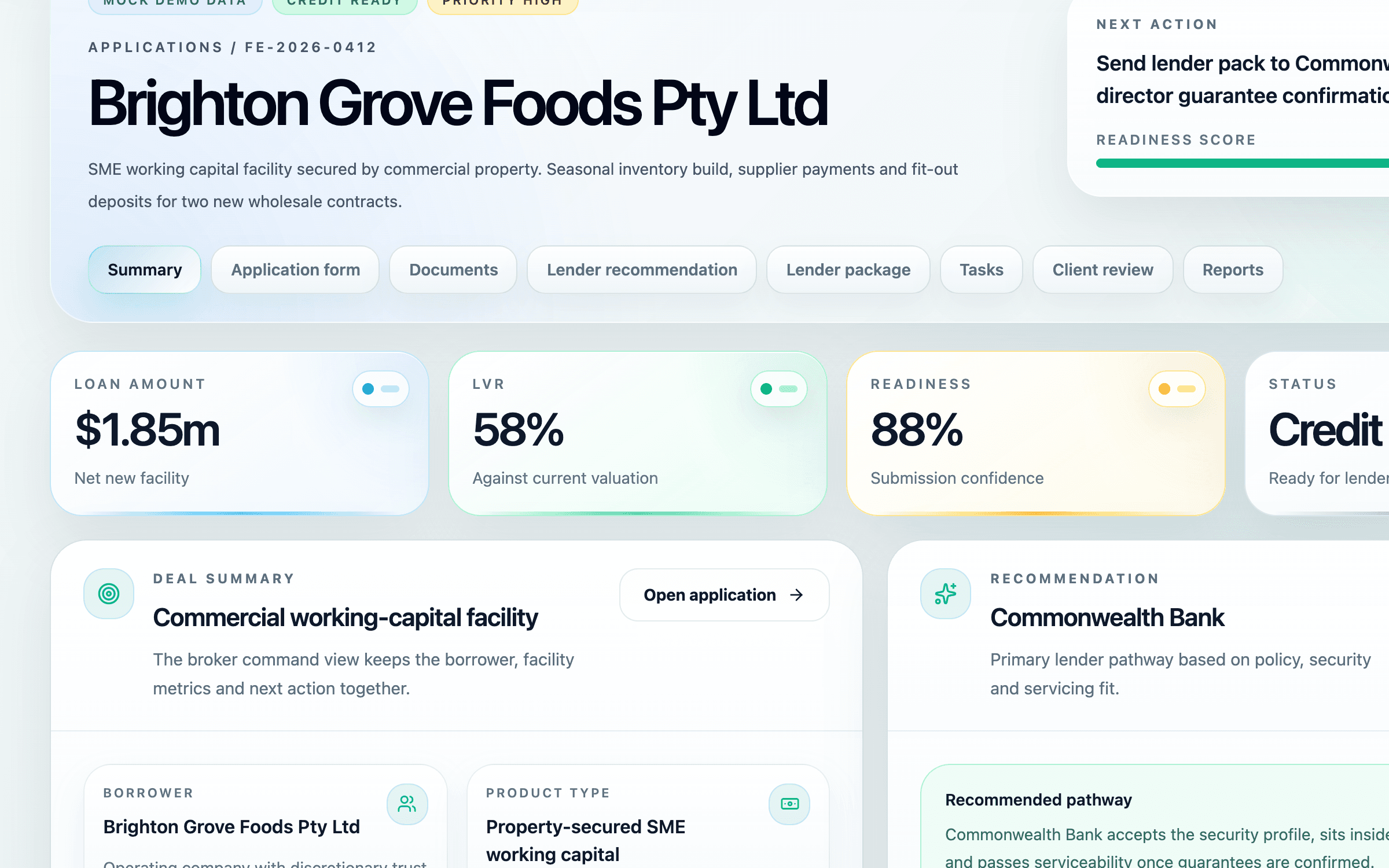 Deal view
The deal workspace tool keeps status, borrower context, funding details, document readiness, and next actions attached to the same commercial file.
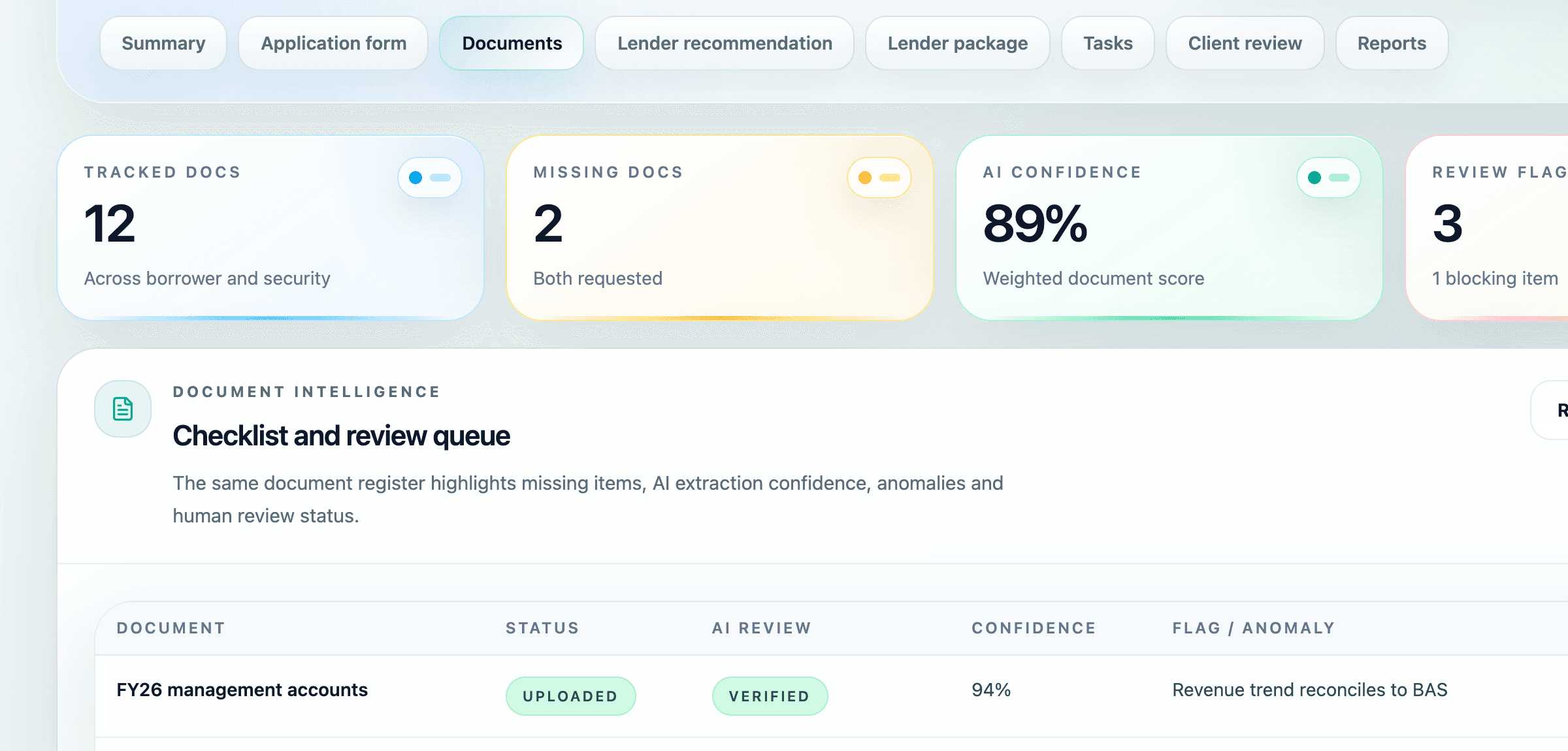 Document view
The document intelligence tool keeps uploaded material, missing evidence, review status, and document issues visible before the file is packaged or sent for review.
Borrower, entity, security, funding, servicing, and document context can stay together instead of being rebuilt across tools.
Lender-fit output, document status, and pack material are framed as review support, with human approval before external use.
Missing items, source gaps, exceptions, and open tasks remain visible before a broker or lender team relies on the pack.
These pages give brokers, search systems, and AI answer engines clearer source material on lender matching, document intelligence, pack preparation, and where broker judgement remains required.
A plain-language definition of commercial finance broker software, what it should do, and how it differs from a general CRM.
What to check before choosing commercial finance broker software, framed as a comparison checklist rather than a feature list.
What aggregators and broker groups should expect from shared commercial finance software across a network of brokers.
These answers are designed to reduce uncertainty before a demo or access request, while keeping pricing and commercial terms in the normal pricing conversation.
No. It is better treated as a guided beta pilot, not a generic free trial. The aim is to test a small number of real or mock commercial files with onboarding, feedback, and clear success criteria.
Yes. Mock files are useful for the first walkthrough, especially before sharing client information. Live or recent files can be introduced once the workflow and access settings are clear.
No. Financial Edge AX is designed as a commercial finance operating layer for deal capture, document intelligence, lender-fit analysis, and submission outputs. A CRM can still manage relationship history and pipeline activity.
No. Financial Edge AX supports broker analysis, lender-fit context, document readiness, and submission preparation. Human judgement remains responsible for advice, lender selection, and final decisions.
A small set of representative files, a clear owner, access for the broker and support users involved, and willingness to compare the platform workflow against the current manual process.
The team reviews workflow fit, time saved, submission quality, and implementation needs. If the pilot is useful, the next step is paid access aligned to the team size and operating model.
Use the access workflow if your team wants to run a guided beta pilot across selected commercial files, test lender-fit visibility, review document intelligence, and compare reusable outputs against the current manual process.