
Eligibility check
Confirm criteria fit before time is spent
Let brokers, introducers, and internal lender teams test pass / refer / fail against lender-owned metrics before BDM or credit time is pulled into the file.
Help us measure page flow and campaign performance. Essential forms, anti-spam, and security stay active either way.
Financial Edge AX gives Australian brokers, introducers, and internal lender teams a lender-owned eligibility path before BDM or credit time is spent, then turns each opportunity into a verified deal pack with pass / refer / fail signals, manual-review flags, and condition tracking through settlement.
The lender value is practical: answer eligibility earlier across channels, receive a properly packaged file, let clean deals move faster, and keep post-approval conditions visible until settlement.
Let brokers, introducers, and internal lender teams test pass / refer / fail against lender-owned metrics before BDM or credit time is pulled into the file.
Submission data, documents, and checklist status arrive in one workspace. Low-confidence or missing items are highlighted for manual review before credit assessment.
Clean, in-criteria, fully packaged deals can move toward auto approval or rapid sign-off while borderline, referred, or low-confidence files stay with credit.
Conditions, owners, outstanding evidence, broker or direct-channel responses, and next actions stay attached to the file from the first eligibility check through settlement.
The lender workflow is backed by product surfaces that broker-facing and internal lender teams use to keep a commercial file structured, checked, and moving.
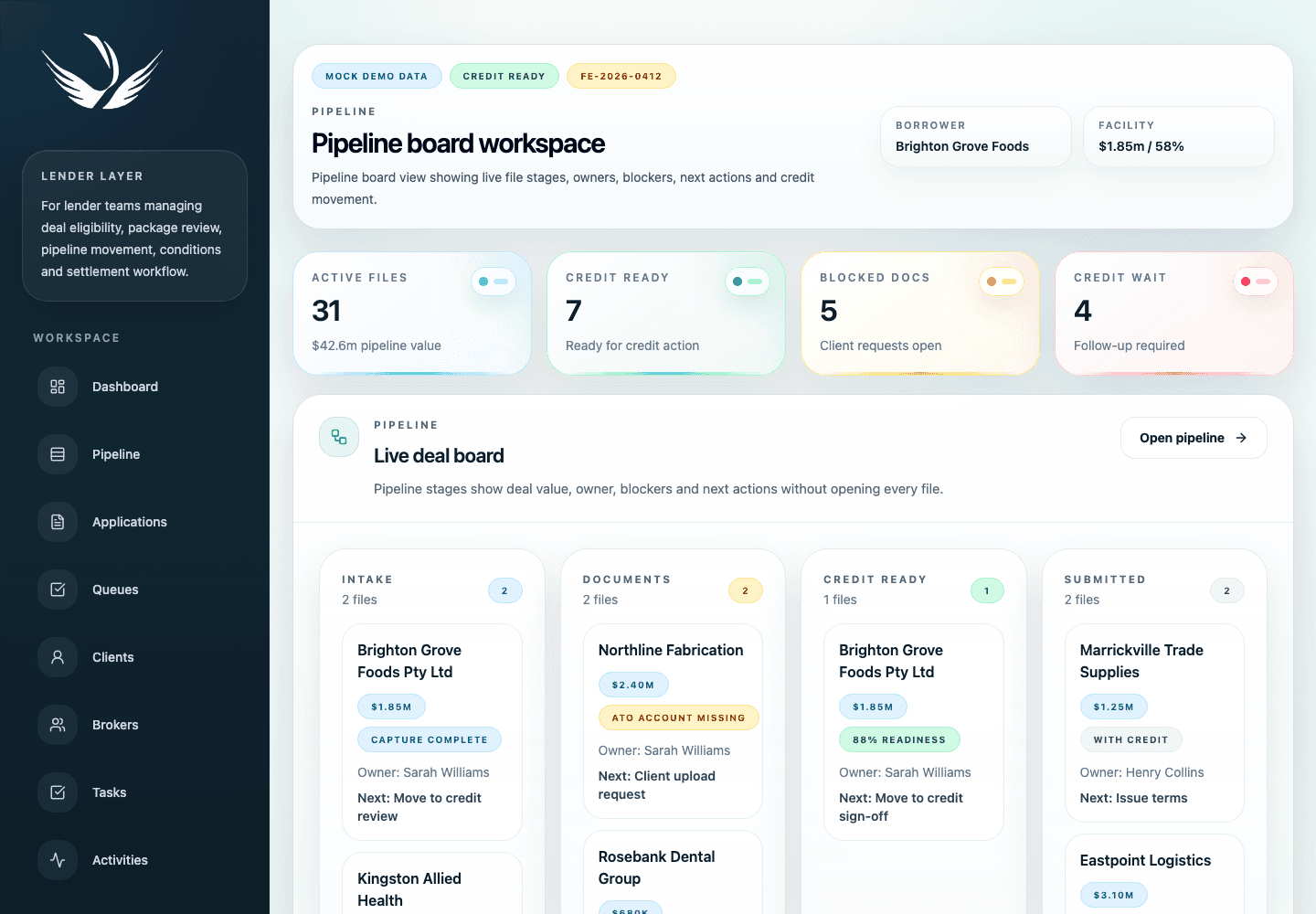
A single lender-owned pipeline view for deal status, ownership, blockers, next actions, credit readiness, and settlement movement.
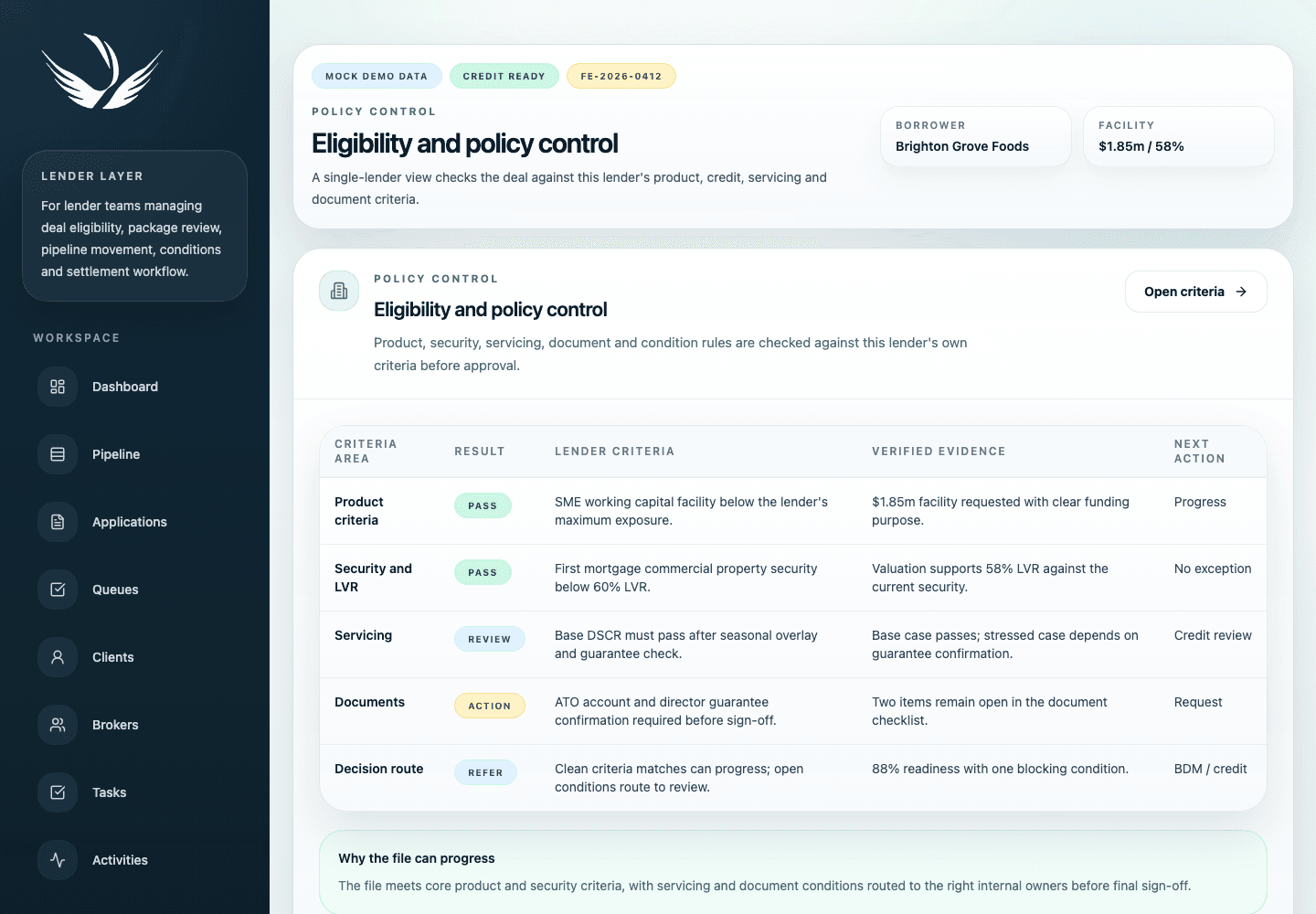
Pass, refer, and fail outcomes are shown against this lender's own product, credit, servicing, and document criteria.
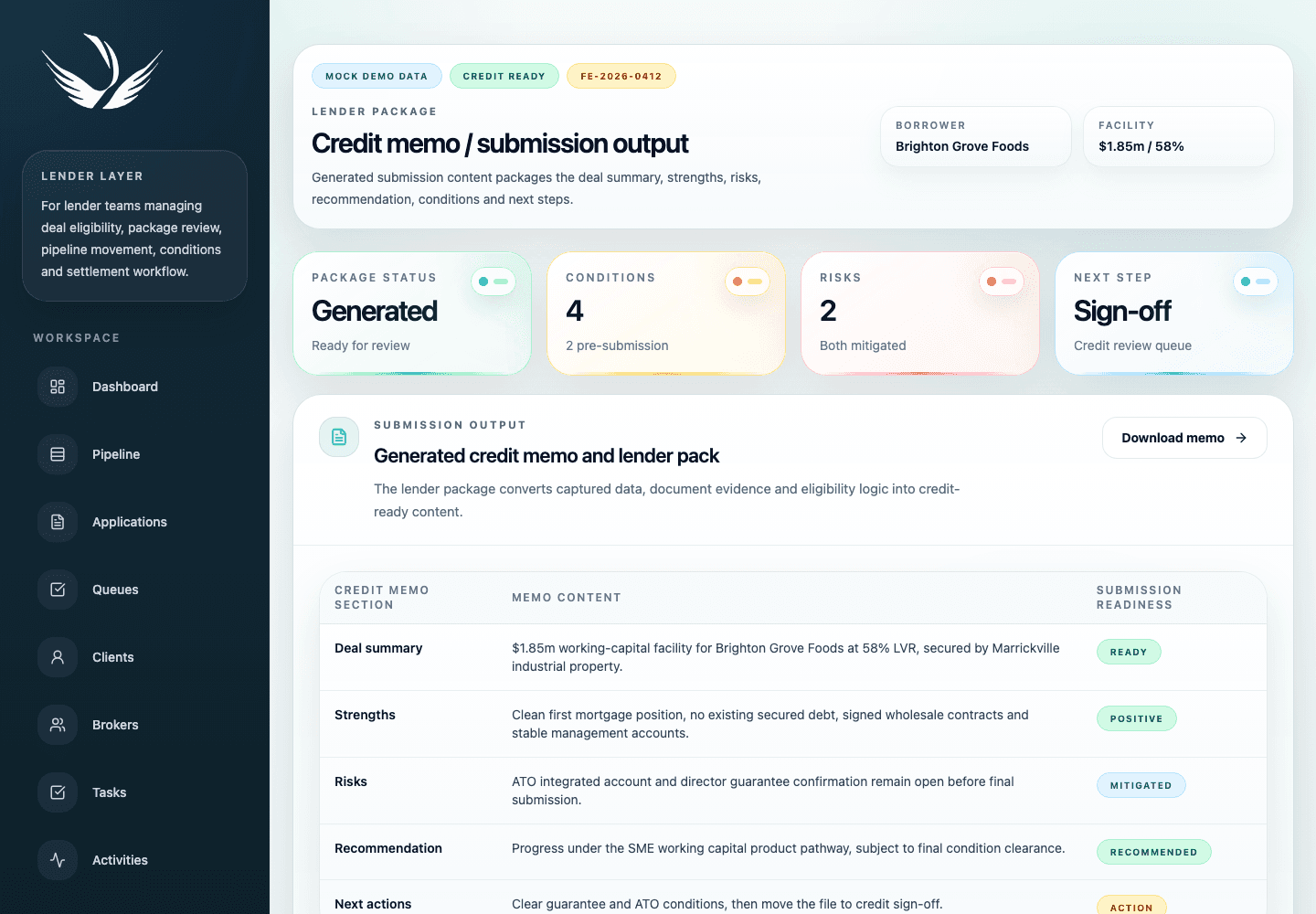
Structured pack outputs keep verified facts, document readiness, conditions, and credit sign-off context in one record.
The workflow shows broker, introducer, and direct intake eligibility checks feeding verified documents, exception handling, controlled approval paths, condition management, and outcome intelligence.
Broker, introducer, and direct intake checks feed verified packs, exception handling, controlled auto-approval support, live conditions, and outcome intelligence.
Financial Edge AX can help lenders standardise lender-owned eligibility checks, verify deal packs, prepare controlled auto-approval pathways, and preserve credit-team oversight for referred, borderline, and low-confidence files.
Encode lender-owned criteria so brokers, introducers, and internal teams see pass / refer / fail before BDM or credit time is requested.
Check documents against the required list, reconcile submitted data, and send low-confidence files to manual review before assessment.
Allow clean in-criteria packaged deals to follow lender-approved fast paths while credit teams focus on borderline and exception files.
Track conditions, owners, evidence, sign-off, and settlement blockers from approval through completion.
The lender story now includes the operational controls behind eligibility and recommendation quality: product settings, appetite rules, postcode policy, scenario comparison, regression testing, reporting, and audit visibility.
Maintain broker-facing guide content, submission forms, document requirements, and product instructions from the same lender-owned control layer.
Control the products that appear in eligibility and recommendation flows, including grouped product sets for regions, channels, and lending programs.
Represent sector appetite, security appetite, leverage constraints, excluded locations, postcode policy sets, and exception settings in structured form.
Attach source policy references and compare scenarios side by side before a criteria change is pushed into broker or direct-intake workflows.
Test lender settings against known scenarios, detect unexpected ranking or eligibility movement, and keep policy changes safer before release.
Review activity, channel movement, near-matches, lost opportunities, approval/decline outcomes, and performance reporting from the lender layer.
Financial Edge AX can support lender-facing workflows through eligibility logic, verified deal packs, exception context, role-aware reporting, controlled approval paths, and intelligence from real commercial finance outcomes.
Lender-owned pass / refer / fail eligibility checker for broker, introducer, and direct intake against product criteria, leverage, borrower, security, purpose, urgency, and servicing metrics
Policy workbench for product guides, forms, approved products, master product sets, appetite profiles, postcode policy, and policy links
BDM and direct-intake routing that shows which questions can self-serve and which referred files need relationship or credit context
Fully packaged deal inbox with application data, required documents, checklist coverage, confidence signals, and open evidence requests
Document intelligence and verification status for source gaps, missing items, anomalies, and low-confidence files needing manual review
Controlled auto-approval support for clean, in-criteria, fully packaged deals under lender-approved rules and authority settings
Scenario comparison, policy regression packs, diagnostic checks, and sandbox testing before criteria changes affect live routing
Manual-review queues for borderline deals, policy exceptions, low-confidence documents, and files needing credit-team sign-off
Condition, owner, SLA, and settlement tracking so post-approval requirements stay attached to the deal record
Audit trails and outcome intelligence across eligibility checks, approvals, declines, conditions, settlements, and channel feedback
Lenders can start with Starter policy coverage, then move into quote-scoped partnership layers that add portal control, distribution intelligence, and enterprise integration depth.
For lenders that want their own product criteria and guide details maintained without managing a live portal workspace.
Essentials access for active lender relationships that want profile control, policy updates, package visibility, alerts, and monthly reporting.
The core lender workspace for package review, status workflow, product sets, postcode criteria, document checklists, analytics, and exports.
Enterprise access for lenders managing multiple products, regions, BDM and direct-channel routing, near-match reporting, policy regression, API access, governance, and integrations.
The same structured record can improve broker guidance, direct intake triage, BDM workload, credit-team review, auto-approval readiness, condition tracking, and post-settlement learning.
| Stage | Current friction | Financial Edge AX improvement |
|---|---|---|
| Eligibility check | Broker, introducer, and direct lender enquiries can arrive before criteria fit is clear, pulling BDM or credit teams into early manual checks. | A lender-owned eligibility checker gives a pass / refer / fail answer across channels and keeps referred questions more specific. |
| Deal packaging | Files arrive with missing documents, unchecked data, and unclear ownership of outstanding items. | Financial Edge AX verifies the pack, crosses off the document list, and flags low-confidence files for manual review. |
| Approval routing | Credit teams spend time on clean files and exceptions with the same manual queue pressure. | Clean in-criteria deals can follow controlled auto-approval or rapid sign-off paths while exceptions stay with credit. |
| Conditions and settlement | Conditions, evidence requests, broker or direct-channel responses, and settlement blockers drift across emails and spreadsheets. | Conditions, owners, next actions, sign-offs, and settlement status stay attached to the same verified deal record. |
These guides connect the lender product page to deeper source material on deterministic policy logic, structured credit intelligence, and the boundary between workflow automation and lender decisioning.
What private credit and non-bank lender teams should expect from commercial finance software on the receiving side of a broker submission.
A practical guide to which parts of commercial lending should be controlled by deterministic logic instead of free-form AI.
A definition of structured credit intelligence and why commercial finance teams need better records before they need more automation.
Use the partnership workflow if your team wants to understand how pass / refer / fail eligibility, verified documents, controlled auto approvals, manual-review queues, and condition tracking could support lender operations.